
Three things changed bitcoin mining between the April 2024 halving and October 2026. The block subsidy halved, from 6.25 to 3.125 BTC. Network difficulty rose about 63%, from about 86 T before the halving to 140.58 T at the October 2026 adjustment, after peaking at 155.97 T in October 2025. And the efficiency of a current machine improved, with Bitmain’s S21 XP rated at 13.5 J/TH.
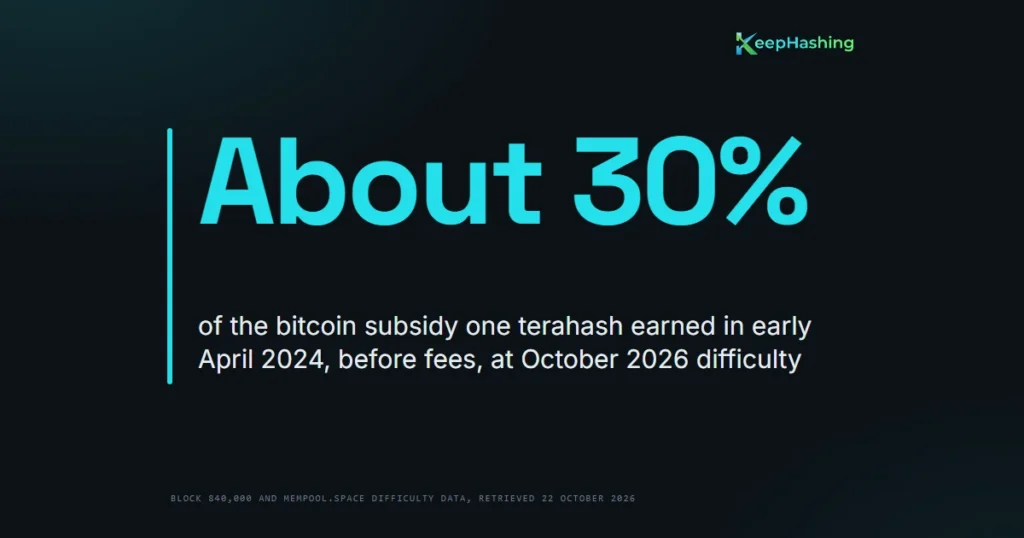
Put the first two together: one terahash of hashing now earns about 30% of the bitcoin subsidy it earned in early April 2024, before transaction fees. That is the trend behind every other trend on this page.
What it means for you depends on four inputs. Two you control: your electricity rate and your machine’s efficiency. Two nobody controls: the bitcoin price and network difficulty over the time the machine runs. This page sets out the facts, dated and sourced, and the arithmetic at UAE rates. It gives no verdict on whether mining will pay, because that depends on the two inputs nobody controls.
The 2024 halving: what actually changed
Bitcoin’s block subsidy halves every 210,000 blocks. The last halving came at block 840,000, mined on 20 April 2024 (UTC). The block before it paid a 6.25 BTC subsidy; block 840,000 paid 3.125 BTC, plus that block’s fees mempool.space, block 840,000.
For a miner, that cut the bitcoin earned per terahash in half overnight, at the same difficulty. Fees still go to the miner who finds the block, but they vary block by block and were not halved.
A miner’s earnings in fiat terms also depend on the bitcoin price, which this page does not quote. What the halving did, in units nobody can argue with, is halve the subsidy each unit of work earns.
Network difficulty and hashrate since the halving
Difficulty is the network’s measure of how much work it takes to find a block. It adjusts every 2,016 blocks, about every two weeks, to keep blocks coming roughly every ten minutes. It rises when more machines come online and falls when machines switch off. A higher difficulty means each terahash finds a smaller share of the blocks.
| Date of adjustment | Block | Difficulty |
|---|---|---|
| 10 April 2024, before the halving | 838,656 | 86.4 T |
| 9 October 2024 | 864,864 | 92.0 T |
| 19 April 2025 | 893,088 | 123.2 T |
| 29 October 2025, the record | 921,312 | 155.97 T |
| 14 June 2026 | 953,568 | 124.93 T |
| 16 October 2026, latest at retrieval | 971,712 | 140.58 T |
mempool.space mining data, retrieved 22 October 2026
Three things stand out:
- Difficulty is 63% higher than before the halving. 140.58 against 86.4 T. Machines kept coming online after the subsidy cut.
- It peaked in October 2025 and has not returned to the record. The October 2026 figure is about 10% below the 155.97 T record.
- 2026 has been volatile. The adjustments this year include a fall of 11.16% in February, a rise of 14.73% two weeks later, and a fall of 10.09% in June.
Network hashrate is estimated from difficulty and block times, so it is an estimate rather than a count. On mempool.space’s figures, the 30-day average was about 995 EH/s to 21 October 2026, against about 1,065 EH/s a year earlier and about 616 EH/s in the month before the halving.
What the two trends do together
Halve the subsidy and raise difficulty by 63%, and the subsidy earned per terahash falls to about 0.5 × 86.4 ÷ 140.58 = 0.31 of its early-April 2024 level. That is before fees, and before any change in the bitcoin price. It is why efficiency matters more now than it did two years ago: each terahash earns less, so what it costs in electricity is a larger share of what it brings in.
Machine efficiency: where current hardware sits
Efficiency is measured in joules per terahash (J/TH): how much energy each unit of work costs. Lower is better. If the term is new, start with what an ASIC miner is and how it works.
| Machine | Hashrate | Power | Efficiency |
|---|---|---|---|
| Antminer S21 XP | 270 TH/s | 3,645 W | 13.5 J/TH |
| Antminer S21 Pro | 234 TH/s | 3,510 W | 15 J/TH |
| Antminer S21 | 200 TH/s | 3,500 W | 17.5 J/TH |
| Whatsminer M60S | 184 to 188 TH/s (three bins) | 3,404 to 3,478 W | 18.5 J/TH |
Bitmain S21 XP specification Bitmain S21 Pro specification Bitmain S21 specification MicroBT M60S product page
MicroBT lists a power figure for each M60S bin: 3,404 W, 3,441 W and 3,478 W, all at 18.5 J/TH. Bitmain states a tolerance of ±3% on hashrate and ±5% on power for the S21 Pro and S21 XP.
The spread between the most and least efficient machines in this table is 5 J/TH, which is a 37% difference in electricity per terahash. Heat is the other half of the choice in the Gulf: MicroBT lists an operating range of -5 to 35 C for the air-cooled M60S, and Bitmain lists 45 C as the upper limit for the S21 family. Our Whatsminer M60S vs Antminer S21 comparison works through both.
UAE power costs: the arithmetic
DEWA bills residential and commercial premises on the same slab table: 0.230 AED per kWh up to 2,000 kWh a month, 0.280 to 4,000, 0.320 to 6,000 and 0.380 above 6,000. Industrial connections pay 0.230 AED up to 10,000 kWh and 0.380 above. A fuel surcharge of 0.060 AED applies to every kWh, and 5% VAT applies to the bill. On a premises already above 6,000 kWh a month, a miner’s kWh land in the top band, at a marginal 0.44 AED DEWA slab tariff, checked October 2026.
ADDC in Abu Dhabi charges 20 fils per kWh for commercial premises. Its page says charges include 5% VAT, but it is titled 2025 and reads “Effective 01/01/2018”, so check the current rate on addc.ae ADDC business rates and tariffs.
For one machine running continuously for a 30-day month:
| Machine | kWh a month | DEWA at 0.44 AED, before VAT | ADDC commercial at 0.20 AED |
|---|---|---|---|
| Antminer S21 XP | 2,624 | about AED 1,155 | about AED 525 |
| Antminer S21 Pro | 2,527 | about AED 1,112 | about AED 505 |
| Antminer S21 | 2,520 | about AED 1,109 | about AED 504 |
| Whatsminer M60S (186 TH/s bin, 3,441 W) | 2,478 | about AED 1,090 | about AED 496 |
Formula
Monthly kWh = watts ÷ 1,000 × 24 × 30
Monthly cost = monthly kWh × your marginal rate per kWh (add any surcharge, then VAT)
The machines draw almost the same power. What differs is the work each does for it. The full DEWA worked example is in what one miner adds to a DEWA bill.
Under the FTA’s clarification VATP039, mining for your own account is outside the scope of VAT, and input VAT on its costs is not recoverable, so the VAT on your electricity is a cost FTA Public Clarification VATP039.
Electricity per terahash, by rate
This is the number to set against whatever a terahash earns on the day you check. It is arithmetic from efficiency and tariff, not a forecast.
| Efficiency | kWh per TH per day | DEWA at 0.44 AED | ADDC at 0.20 AED | Hosting at 6 to 8 US cents |
|---|---|---|---|---|
| 13.5 J/TH | 0.324 | AED 0.143 | AED 0.065 | USD 0.019 to 0.026 |
| 15 J/TH | 0.360 | AED 0.158 | AED 0.072 | USD 0.022 to 0.029 |
| 17.5 J/TH | 0.420 | AED 0.185 | AED 0.084 | USD 0.025 to 0.034 |
| 18.5 J/TH | 0.444 | AED 0.195 | AED 0.089 | USD 0.027 to 0.036 |
Published UAE hosting rates ranged from about 6 to 8 US cents per kWh in September 2026. That is market context from provider pages, not our price; our guide to ASIC miner hosting rates in the UAE explains how to compare quotes per kWh.
The revenue side, called hashprice, is what one terahash earns per day. It moves with the bitcoin price, fees and difficulty, so we do not print it. Mining pools and hashprice indexes publish it live. Compare the live figure with the row for your machine and the column for your rate.
The next halving
At block 1,050,000 the subsidy halves again, to 1.5625 BTC. On 22 October 2026 the chain stood at block 972,618, so 77,382 blocks remain. At the ten-minute target that points to about April 2028. Treat that as an estimate from block height, not a date: blocks come faster when hashrate rises and slower when it falls.
The same arithmetic as 2024 applies. At unchanged difficulty, each terahash would earn half the subsidy it earns now. The machines that keep running through a halving are the ones whose electricity cost per terahash stays below what a terahash earns, which is why J/TH, at your rate, is the number that ages a machine.
Why this page gives no verdict
A supplier can tell you the specs, the tariffs, the hosting range and the arithmetic. A supplier cannot tell you what the bitcoin price or difficulty will be next year. A page that promises a payback period or “profitable below X cents” has made an assumption about both and not shown it.
So we publish the inputs and the method. What it earns is your calculation, at your rate, on the day you make it.
What a UAE buyer does with this
- Decide where the machine runs first. At home, on a commercial site, or in hosting on facility power. That sets your rate. For why home mining rarely works, see crypto mining in the UAE.
- Find your row and column in the table above.
- Check today’s hashprice from a pool or index and compare.
- Get quotes in the efficiency tier your rate justifies.