
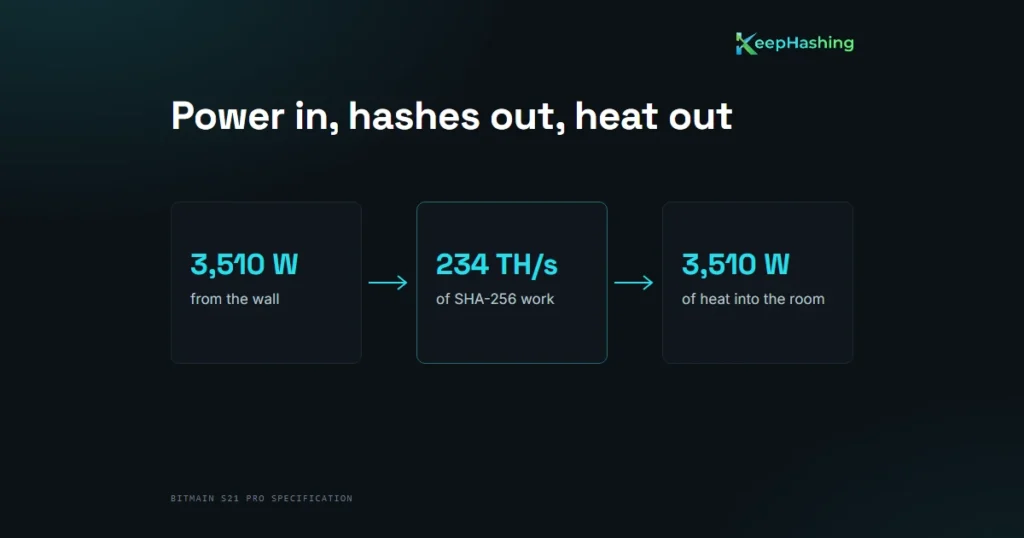
An ASIC miner is a machine built around chips that do one job only. ASIC stands for application-specific integrated circuit. In a bitcoin miner, every chip is designed to run SHA-256, the hashing function behind bitcoin’s proof of work, as fast as possible on as little power as possible. It cannot do anything else, and it does that one thing far better than a general-purpose computer.
That is the whole idea. The rest of this guide covers what is inside the box, the three numbers that describe any miner, why most buyers in the UAE do not run one at home, and what to decide before you buy your first.
How an ASIC miner works
A miner takes in electricity and turns it into hashing work. It sends that work to a mining pool, and the pool pays out to your own wallet in proportion to the work your machine contributes. Almost every watt it draws ends up as heat.
Inside an air-cooled unit you will find four main parts:
- Hashboards. Long boards lined with the ASIC chips. A typical machine carries several, and each one does a share of the work.
- Control board. A small computer that runs the firmware, talks to the pool and serves the machine’s web dashboard on your local network.
- Power supply (PSU). Converts the wall supply into the voltage the hashboards need.
- Fans. Push air through the hashboards and out of the back of the machine.
Hydro-cooled models replace the fans with a water loop. MicroBT’s M63S, for example, needs a coolant loop and a three-phase 380 to 480 V supply, so it suits farms and containers rather than a single machine in a room.
The three numbers that describe any miner
Every spec sheet leads with three figures. Learn these and you can compare any two machines.
Hashrate is how much work the machine does, in terahashes per second (TH/s).
Power is what it draws from the wall, in watts (W).
Efficiency is how much energy each terahash costs, in joules per terahash (J/TH). Lower is better. The three are linked: power = hashrate × efficiency.
Bitmain’s figures for two current Antminer models show how it works Bitmain S21 Pro specification Bitmain S21 XP specification:
| Model | Hashrate | Power | Efficiency |
|---|---|---|---|
| Antminer S21 Pro | 234 TH/s | 3,510 W | 15 J/TH |
| Antminer S21 XP | 270 TH/s | 3,645 W | 13.5 J/TH |
234 × 15 = 3,510, and 270 × 13.5 = 3,645. If a listing’s figures do not multiply out, ask why.
At UAE electricity rates, efficiency matters more than headline hashrate, because you pay for every joule for as long as the machine runs.
Bitcoin miners and the rest
Most ASIC miners sold in the UAE are bitcoin (SHA-256) machines from two manufacturers: Bitmain, which makes the Antminer range, and MicroBT, which makes the Whatsminer range. You can see both on our Antminer range in the UAE and Whatsminer range in the UAE pages.
Some ASICs are built for other algorithms. Bitmain’s Antminer L9, for example, runs scrypt, the algorithm used by Litecoin and Dogecoin. Bitmain rates it at 16 GH/s and 3,360 W. A scrypt machine and a bitcoin machine are not interchangeable, so check the algorithm before anything else.
ASIC miner vs GPU
A graphics card is a general-purpose chip that can do many kinds of maths reasonably well. An ASIC does one kind of maths extremely well. On bitcoin’s SHA-256 work, a GPU cannot compete with a purpose-built ASIC on either speed or energy per hash, which is why bitcoin mining is done on ASICs. The trade-off is that an ASIC has no second use: when it is no longer efficient enough for your power rate, it is sold on, repaired or retired.
Can you run an ASIC miner at home in the UAE?
The legal position, emirate by emirate, is covered in our guide to the legal position. This section is about whether it works in practice, and for most people it does not. One Antminer S21 Pro running around the clock uses 3.51 kW × 24 × 30 = about 2,527 kWh a month. DEWA bills residential and commercial premises on the same slab table (0.230 / 0.280 / 0.320 / 0.380 AED per kWh at 2,000 / 4,000 / 6,000 kWh a month), plus a 0.060 AED fuel surcharge on every kWh, so the machine’s kWh land at a marginal 0.44 AED. That is about AED 1,112 a month before VAT for one machine DEWA slab tariff, checked October 2026.
Then there is the heat and the noise. Bitmain rates the S21 Pro at 76 dBA. MicroBT lists an operating range of -5 to 35 C for its air-cooled Whatsminer M60S, and Bitmain lists 45 C as the upper limit for the S21 family. A UAE summer goes past 35 C for months.
That is why most UAE buyers run their machine in a facility instead. With ASIC miner hosting, you own the machine, it runs on a commercial or industrial connection, and your pool pays your own wallet.
What to decide before you buy your first
- Where it will run. Home, hosted, or your own commercial site. This decides everything else.
- Your power rate. Your top tariff band, or the rate per kWh a hosting provider quotes you.
- The efficiency tier that rate justifies. The higher your rate, the more each J/TH costs you.
- New or tested used. A new unit ships sealed with the manufacturer’s warranty. Bitmain’s warranty-check article says new miners outside the 19 series are covered for “generally 180 days” from dispatch; MicroBT’s product page offers one year on models such as the M60S. A used unit should come with a recorded stability run and serial photos instead.
- The serial number. Check it against the manufacturer’s warranty lookup before you pay, whoever you buy from.