
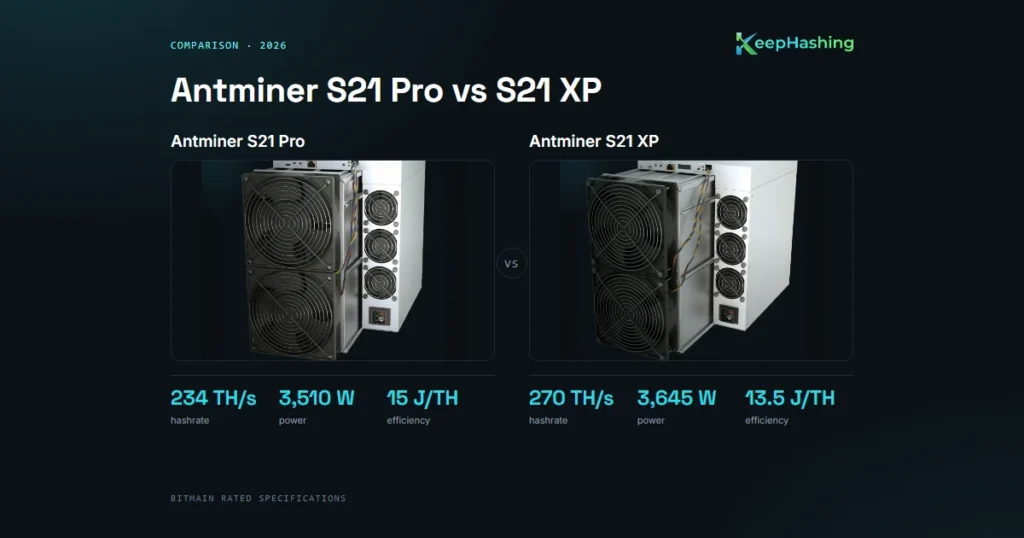
On Bitmain’s rated figures, the Antminer S21 XP is the more efficient machine: 13.5 J/TH against the S21 Pro’s 15 J/TH. The S21 Pro is the value pick from the same generation. Which one wins for you is decided by two things: your electricity rate and how long you will run the machine.
This comparison shows the power gap in AED at DEWA and ADDC rates and at the published UAE hosting range, so you can rerun it on your own tariff. There is no verdict here, because your rate and your two quotes decide it, not us.
The rated specs side by side
| Antminer S21 Pro | Antminer S21 XP | |
|---|---|---|
| Hashrate | 234 TH/s (±3%) | 270 TH/s (±3%) |
| Power on wall at 25 C | 3,510 W (±5%) | 3,645 W (±5%) |
| Efficiency | 15 J/TH | 13.5 J/TH |
| Input | 220 to 277 V, 20 A | 220 to 277 V, 20 A |
| Noise | 76 dBA | 76 dBA |
| Operating temperature | -20 to 45 C | -20 to 45 C |
| Dimensions | 450 x 219 x 293 mm | 449 x 219 x 293 mm |
| Net weight | 20 kg | 18.7 kg |
Bitmain S21 Pro specification Bitmain S21 XP specification
Bitmain states that “the actual Hashrate value fluctuates by ±3%, and the actual Power on wall and Power efficiency on wall fluctuate by ±5%”. A unit inside those bands is normal. Bitmain prints its efficiency unit as J/Ksol on the S21 XP page; for SHA-256 miners it reads as J/TH.
The tolerances do not close the gap. At the edge of its band, an S21 Pro runs at 14.25 J/TH. An S21 XP at the other edge runs at 14.18 J/TH. Even the weakest XP inside Bitmain’s tolerance is more efficient than the best Pro.
Read the headline numbers carefully. The XP delivers about 15% more hashrate for about 4% more power. The figure that matters for running cost is the 1.5 J/TH between them. Product detail is on the S21 Pro and S21 XP pages.
What the efficiency gap costs in electricity
Compare the two at the same output. Producing the S21 Pro’s 234 TH/s at the S21 XP’s efficiency saves 1.5 J/TH × 234 TH/s = 351 W, continuously. Over a 30-day month, that is 351 W × 24 × 30 = about 253 kWh.
The rates used, as published:
- DEWA, Dubai. DEWA bills residential and commercial premises on the same slab table: 0.230 AED per kWh up to 2,000 kWh a month, 0.280 to 4,000, 0.320 to 6,000, and 0.380 above 6,000. Industrial connections pay 0.230 AED up to 10,000 kWh and 0.380 above. A fuel surcharge of 0.060 AED applies to every kWh, and 5% VAT applies to the bill. One S21 alone uses more than 2,500 kWh a month, so its kWh land in the top band: 0.380 plus 0.060 is a marginal 0.44 AED per kWh DEWA slab tariff, checked October 2026.
- ADDC, Abu Dhabi. 20 fils per kWh for commercial premises, flat, and 28.6 fils for industrial connections up to 1 MW. ADDC’s page says charges include 5% VAT; it is titled 2025 but reads “Effective 01/01/2018”, so check the current rate on addc.ae ADDC business rates and tariffs.
- A hosting facility. Published UAE hosting rates ranged from about 6 to 8 US cents per kWh in September 2026. That is market context from provider pages, not our price.
| Rate | Monthly cost of the 253 kWh gap |
|---|---|
| ADDC commercial, 0.20 AED | about AED 51 (ADDC rate as published, page reads effective 2018) |
| DEWA top slab plus fuel surcharge, 0.44 AED | about AED 111, before 5% VAT |
| Hosting at 6 US cents | about USD 15 |
| Hosting at 8 US cents | about USD 20 |
Formula
Watts gap = hashrate (TH/s) × J/TH gap
Monthly kWh = watts gap ÷ 1,000 × 24 × 30
Monthly cost = monthly kWh × your marginal rate per kWh (add any surcharge, then VAT)
The same gap is more than twice as expensive on DEWA’s top slab as on ADDC’s commercial rate. Your tariff, not the machine, sets how much the 1.5 J/TH is worth.
Cost per terahash, and how to weigh a higher quote
The two machines produce different amounts of hashrate, so compare them per terahash, not per unit.
Power per terahash. One TH/s running for a 30-day month uses J/TH × 0.72 kWh. At DEWA’s marginal 0.44 AED, that is about AED 4.75 a month for each terahash on the S21 Pro and about AED 4.28 on the S21 XP. The difference is about AED 0.48 per terahash per month. At ADDC’s 20 fils it is about AED 0.22, and at the published hosting range about 6 to 9 US cents.
Price per terahash. Divide each quote by the machine’s hashrate. That gives you what each terahash costs to buy.
Putting them together. Take the difference in price per terahash and divide it by the monthly power difference per terahash at your rate. The answer is the number of months of running it takes for the XP’s lower power use to cover its higher price per terahash. Set that against how long you expect to run the machine.
That is arithmetic, not a forecast. It says nothing about what the machine earns, because that depends on the bitcoin price and network difficulty, which nobody controls. This page carries no prices; you insert your two quotes.
Build, cooling and noise
The two machines share almost everything you would plan a site around. Same form factor within a millimetre, same 220 to 277 V input at 20 A, same 76 dBA noise rating, same published operating range of -20 to 45 C. The XP is 1.3 kg lighter.
The XP draws 135 W more per machine, so it puts 135 W more heat into the room or rack. Per terahash, it produces less heat than the Pro. In a 45 C UAE summer, both machines sit at the top of their published range in an unconditioned space, so the site, not the model, is usually the deciding factor. A hosted rack or conditioned air is the usual answer for both.
Used S21 Pro or new S21 XP
In the UAE, the real choice is often a tested used S21 Pro against a new S21 XP. Each comes with different evidence.
A new unit ships sealed, so the manufacturer’s warranty stays intact. Bitmain’s warranty-check article says the warranty on new miners outside the 19 series is “generally 180 days”, counted from the official dispatch date Bitmain, Miner Warranty Check. Run the serial through Bitmain’s lookup before you pay.
A used unit trades warranty for test evidence. Every used machine we sell goes through our Deira bench first: serial photos before dispatch, rated hashrate verified, a recorded stability run with hashrate and temperatures logged, factory firmware confirmed, and written warranty terms with the quote. See tested used miners. Whoever you buy from, ask for the same.
The efficiency premium is worth paying when your horizon is long and your rate is high. It matters less when you run on a low commercial or facility rate, or when you plan to upgrade within the next generation.
Which one for which buyer
A hosted buyer on a facility rate. At the published hosting range, the gap is small per terahash but paid for as long as the machine runs. Over a long horizon the S21 XP’s efficiency compounds. Over a short one, a tested used S21 Pro may cover more terahash for the same money. Run the per-terahash method with both quotes, and see how hosting in the UAE is quoted.
A small commercial site in Dubai or Abu Dhabi. On DEWA’s top slab, the 1.5 J/TH gap is worth more than twice what it is on ADDC’s commercial rate. The higher your rate, the stronger the case for the XP.
A budget entry. A tested used S21 Pro gets you current-generation efficiency at a lower entry cost. Check the serial, the stability run and the written terms before you pay.
Bitmain’s newer generation exists above both machines; ask for it on WhatsApp if you want it in the comparison. If you are weighing Bitmain against MicroBT, see the Whatsminer M60S vs Antminer S21 comparison, or browse the full Antminer range in the UAE.