
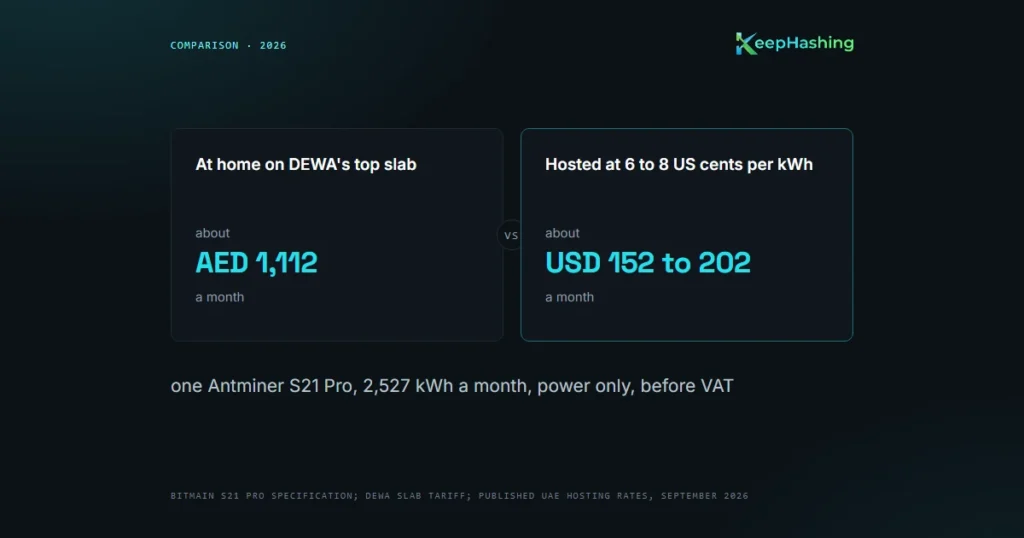
Published ASIC miner hosting rates in the UAE ranged from about 6 to 8 US cents per kWh in September 2026. That is market context from provider pages, not our price, and the providers are not named here. For one Antminer S21 Pro, it works out at roughly USD 152 to 202 a month in power. The same machine at home in Dubai, billed at DEWA’s top slab, costs about AED 1,112 a month before VAT.
The rate per kWh is only half the comparison. What it includes, how your power is measured and what happens when a machine fails decide what you actually pay. This guide covers the numbers, the formula you can rerun at your own rate, and the questions to ask before you sign.
What ASIC miner hosting is, and what it is not
With hosting, you own the machine. It runs in a facility on a commercial or industrial power connection built for the load. You point it at your own mining pool account, and the payouts go to your own wallet address.
It is not renting hashrate and it is not cloud mining. Nobody sells you a share of output. If the paperwork describes anything other than a machine you own placed in someone else’s facility, it is a different product.
What you give up is physical access. That is the trade, and it is why the contract matters as much as the rate. Our own ASIC miner hosting in the UAE is quoted per unit on WhatsApp.
What UAE hosting rates looked like in September 2026
Published rates on UAE provider pages ranged from about 6 to 8 US cents per kWh in September 2026. At the dirham’s fixed rate of 3.6725 to the US dollar, that is about 0.22 to 0.29 AED per kWh.
Providers quote in different ways:
- A rate per kWh. You pay for the energy your machine uses, often in US cents.
- A flat monthly fee per machine. The provider prices in the machine’s rated wattage for you.
- A mix. A per-kWh rate plus a setup fee, a deposit or a minimum number of units.
Whatever the format, convert every offer to a cost per kWh, then add the one-off charges spread over the months you expect to stay. That is the only way to compare two offers on the same basis.
What that means for one machine
Take the Antminer S21 Pro. Bitmain rates it at 234 TH/s and 3,510 W, with a stated tolerance of ±5% on power Bitmain S21 Pro specification. Running continuously:
3.51 kW × 24 hours × 30 days = 2,527 kWh a month.
| Where the machine runs | Rate per kWh | Monthly power cost, one S21 Pro |
|---|---|---|
| Home in Dubai, DEWA top slab plus fuel surcharge | 0.44 AED | about AED 1,112, before 5% VAT |
| Home in Abu Dhabi, ADDC expatriate rate above the daily allowance | 0.305 AED | about AED 771 (ADDC page reads effective 2018; check addc.ae) |
| Hosted, low end of the published range | 6 US cents | about USD 152 (about AED 557) |
| Hosted, high end of the published range | 8 US cents | about USD 202 (about AED 742) |
The hosted rows are a published market range from September 2026, not our price. The home rows are power only; the air conditioning needed to remove the heat comes on top.
Formula
Monthly kWh = rated watts ÷ 1,000 × 24 × 30
Monthly cost = monthly kWh × the rate per kWh (add any surcharge, then VAT)
Use your own machine’s wattage and the rate you are actually offered.
Why facility power costs less than a home bill
In Dubai, DEWA bills residential and commercial premises on the same slab table DEWA slab tariff, checked October 2026:
| Monthly consumption | Residential and commercial (AED per kWh) |
|---|---|
| 0 to 2,000 kWh | 0.230 |
| 2,001 to 4,000 kWh | 0.280 |
| 4,001 to 6,000 kWh | 0.320 |
| Above 6,000 kWh | 0.380 |
Industrial connections pay 0.230 AED up to 10,000 kWh a month and 0.380 above it. A fuel surcharge of 0.060 AED applies to every kWh, and 5% VAT applies to the bill. One miner uses more than the whole first slab, so its kWh land in the top band: 0.380 plus 0.060 is 0.44 AED, about 12 US cents. The full slab-by-slab version is in what one miner adds to a DEWA bill.
Abu Dhabi publishes lower business rates. ADDC lists 20 fils per kWh for commercial premises and 28.6 fils for industrial connections up to 1 MW, and its page says charges include 5% VAT. The page is titled 2025 but reads “Effective 01/01/2018”, so check the current rate on addc.ae before you rely on it ADDC business rates and tariffs.
So the published hosting range sits well below Dubai’s top slab of about 12 US cents. Where a facility draws its power, and on which connection, shapes the rate it can offer. Ask.
What the rate should include
A low rate that leaves out the things you need is not a low rate. Ask each provider, in writing, whether the rate covers:
- Rack space and installation.
- Cooling that holds intake air inside your machine’s published operating range through a UAE summer. MicroBT lists -5 to 35 C for the air-cooled Whatsminer M60S; Bitmain lists an upper limit of 45 C for the S21 family.
- Network to your pool.
- Monitoring, and how quickly you are told when a machine stops hashing.
- Fault handling: who diagnoses a failed machine, and whether you get a written diagnosis and quote before any repair work starts.
- One-off charges: setup fee, deposit, minimum number of units, minimum term.
Questions that change the real cost
Is power metered or calculated? A meter bills what your machine draws. A rated figure bills what the manufacturer prints. Bitmain’s ±5% tolerance on the S21 Pro is worth about 126 kWh a month either way, or about USD 8 to 10 at the published range.
What happens in July and August? If the facility cannot hold intake air inside the published range, machines run hot or stop. Ask what intake temperature it holds at the peak of summer.
Who pays for downtime? If a machine sits idle while waiting for a technician, ask whether you are billed for the slot.
Can the rate change? Ask whether it moves when the facility’s own tariff moves, and how much notice you get.
How do you leave? Read the notice period, how the machine is returned, and how a final power reading is settled before you start.
Can you see your machine’s numbers? Your pool dashboard shows each machine as a worker. If a worker disappears or its hashrate drops, you see it there before anyone tells you.
Hosting, your own site or home
Hosting is the usual route for retail buyers. Running your own commercial site makes sense at a scale where you can contract power and cooling yourself, and mining as a business needs a trade licence. Running a miner at home is rarely practical: the slab tariff, the heat and the noise rule it out for most people. The three paths, side by side, are in our guide to crypto mining in the UAE.
VAT and paperwork
The Federal Tax Authority’s clarification VATP039 says mining for your own account is outside the scope of VAT, and that mining on behalf of another person is a taxable supply of services FTA Public Clarification VATP039. How VAT applies to a hosting fee depends on what the provider supplies; ask a tax adviser.