
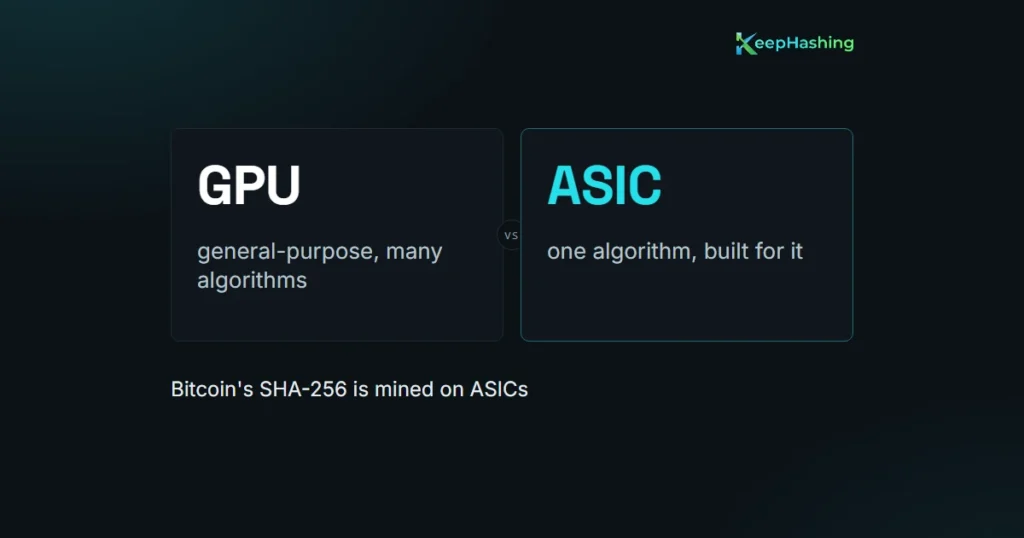
A GPU is a general-purpose chip that can run many kinds of calculation. An ASIC is a chip built to run one calculation only. For bitcoin, that difference settles the question: bitcoin’s proof of work uses the SHA-256 algorithm, and machines built only for SHA-256 do that work far faster and on far less energy per hash than any graphics card. Bitcoin is mined on ASICs.
GPU mining’s largest market closed in 2022, when Ethereum stopped using mining altogether. If you are new to the hardware itself, start with our guide to what an ASIC miner is and how it works. This page covers the comparison: what each chip does, why one wins on bitcoin, and what that means for a buyer in the UAE.
The core difference: one job against many
A graphics card is designed to do many small calculations at once for games, video and graphics work. That flexibility is why it can also be pointed at different mining algorithms. Change the software and the same card works on a different coin.
An ASIC, an application-specific integrated circuit, gives up that flexibility. The chip is designed around one algorithm, and every part of it serves that one job. It cannot be reprogrammed for a different algorithm. In exchange, it does its one job with a speed and an energy efficiency a general-purpose chip cannot reach.
One machine, one algorithm
Bitmain’s own list of algorithms and the Antminer models built for each shows how narrow an ASIC is Bitmain Support, Algorithms and Corresponding ANTMINERs, updated 2 September 2024:
- SHA-256 (bitcoin): the S-series machines.
- Scrypt (Litecoin): the L-series machines, such as the L7.
- Other algorithms each have their own model families, from Equihash to X11.
A bitcoin Antminer cannot mine Litecoin, and a Litecoin Antminer cannot mine bitcoin. Before you buy, check the algorithm first and the hashrate second.
Why bitcoin is ASIC-only
Every bitcoin miner competes with every other miner on the network. Your machine earns in proportion to its share of the network’s total hashrate. When the rest of the network runs purpose-built SHA-256 machines, a general-purpose chip’s share rounds to nothing.
Look at what a current bitcoin ASIC delivers. Bitmain rates the Antminer S21 XP at 270 TH/s, 270 trillion hashes per second, at 13.5 joules per terahash Bitmain S21 XP specification. That efficiency figure, joules per terahash (J/TH), is what decides running cost. A graphics card can technically compute SHA-256, but it is nowhere near that rate or that efficiency on this one algorithm.
So the practical answer to “can I mine bitcoin with a GPU?” is that the software will run, but the card will use electricity without earning a meaningful share.
What happened to GPU mining
For years, the largest GPU-mined coin was Ethereum. That ended on 15 September 2022, when Ethereum moved from proof of work to proof of stake in an upgrade called the Merge. Ethereum’s own site says that “Mining is no longer the means of producing valid blocks”, and that the change cut the network’s energy use by about 99.95% ethereum.org, The Merge.
Some smaller proof-of-work coins can still be mined on graphics cards. But the coin that drove most GPU mining no longer uses mining at all, and bitcoin has been an ASIC market for years.
ASIC vs GPU at a glance
| ASIC miner | GPU | |
|---|---|---|
| What it runs | One algorithm, fixed in the chip | Many algorithms, changed in software |
| Bitcoin (SHA-256) | Built for it | Not competitive |
| Efficiency on its algorithm | Measured in J/TH; Bitmain’s S21, S21 Pro and S21 XP run at 17.5, 15 and 13.5 J/TH | Far lower on SHA-256 |
| Second use | None outside mining its algorithm | Gaming, graphics, computing |
| Form | A self-contained machine with its own PSU and fans | A card inside a computer |
| Heat and noise | About 3.5 kW of heat per current bitcoin unit; Bitmain rates the S21 Pro at 76 dBA | Depends on the card and build |
What it means in the UAE: power and heat
A current bitcoin ASIC is a 3.5 kW machine that runs around the clock. One Antminer S21 Pro, rated by Bitmain at 3,510 W, uses about 2,527 kWh a month Bitmain S21 Pro specification.
DEWA bills residential and commercial premises on the same slab table: 0.230 / 0.280 / 0.320 / 0.380 AED per kWh at 2,000 / 4,000 / 6,000 kWh a month, with a 0.060 AED fuel surcharge on every kWh. On a premises already above 6,000 kWh a month, a miner’s kWh land in the top band, at a marginal 0.44 AED, which comes to about AED 1,112 a month before VAT for one S21 Pro DEWA slab tariff, checked October 2026. Our guide to bitcoin mining electricity cost in the UAE runs the same arithmetic for other machines and tariffs.
The heat is the other half. MicroBT lists an operating range of -5 to 35 C for its air-cooled Whatsminer M60S, and Bitmain lists 45 C as the upper limit for the S21 family. A UAE summer passes 35 C for months. That is why many buyers place their machine in a facility rather than at home; see how ASIC miner hosting works.
Which should you buy?
To mine bitcoin, buy a SHA-256 ASIC. Compare models on J/TH at your power rate, not on headline hashrate. Our Antminer range in the UAE lists the current S21 family.
To mine Litecoin or Dogecoin, buy a scrypt ASIC, such as the Antminer L9.
If you want a machine with a second life outside mining, a GPU keeps that option, but it is not a bitcoin miner.
Whatever you buy, no one can tell you in advance what it will earn. That depends on the coin’s price and network difficulty, which nobody controls. What you can control is the machine’s efficiency and your power rate.