
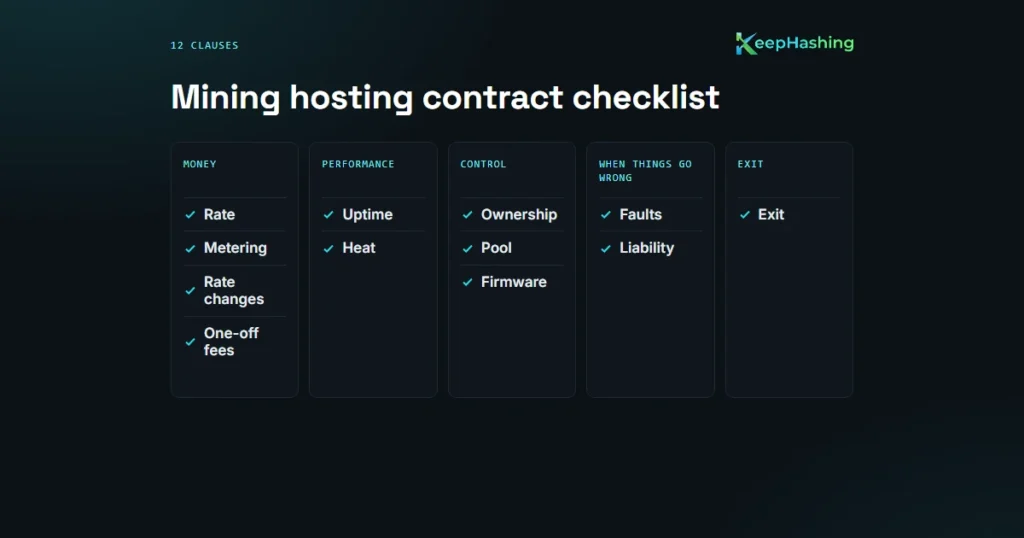
A hosting contract matters as much as the machine you put under it. The rate sets your biggest cost. The uptime and heat clauses decide how many hours it actually hashes. And the fault, liability and exit clauses decide what happens on the bad days, which is when contracts get read.
This is a clause-by-clause checklist for anyone placing an ASIC miner with a hosting provider in the UAE. For each clause it says what to ask, and the wording that should make you stop. It does not compare providers or recommend one.
Before the clauses: what you are buying
Hosting means you own a physical machine and pay a facility for rack space, power, cooling and network. Your pool pays your own wallet. If the offer is a slice of output or a hashrate figure, with no machine and serial number in your name, you are looking at a different product, and this checklist does not apply.
Money
1. The rate, and what it covers
Ask what the rate includes: power only, or power plus cooling, rack space, network and monitoring. Ask whether VAT is included or added. Then convert the whole charge to a cost per kWh, so different quote formats can be compared side by side. Published UAE rates ranged from about 6 to 8 US cents per kWh in September 2026; that is market context from provider pages, not our price. Our guide to ASIC miner hosting rates in the UAE shows the conversion.
Stop if the quote is a per-machine monthly fee with no statement of the power it assumes.
2. How your power is measured
There are two ways: a meter on your machine or rack, or the manufacturer’s rated wattage multiplied by hours. Rated figures carry a tolerance. Bitmain lists the Antminer L9 at 3,360 W ±5% and the L7 at 3,420 W ±10% Bitmain L9 specification Bitmain L7 specification. On a rated basis you pay for the label; on a metered basis you pay for the draw. Either can be fair if the contract says which, and lets you see the readings.
Stop if you cannot get a monthly power figure per machine.
3. Rate changes
Ask whether the facility can change the rate during the term, what triggers a change (its own utility tariff, for example), and how much written notice you get. Ask whether you can leave without penalty if you do not accept a new rate.
Stop if the rate can change at the facility’s discretion with no notice period.
4. Deposit, prepayment and one-off fees
List every charge that is not the monthly rate: setup or installation fee, deposit, months paid in advance, minimum number of units, minimum term. For the deposit, ask what it covers and when and how it comes back.
Stop if the deposit has no written refund terms.
Performance
5. Uptime, and how it is defined
An uptime figure means little until the contract defines it. Ask how it is measured (the facility’s own records or your pool’s worker history), what is excluded (planned maintenance, grid outages, curtailment requested by the utility) and what you get if it is missed. Your pool dashboard records every hour each machine was hashing, so you can check the facility’s figure yourself.
Stop if uptime is promised with no definition and no remedy.
6. Heat
Manufacturers publish an operating range, and a UAE summer passes 35 C for months. MicroBT lists -5 to 35 C for its air-cooled Whatsminer M60S MicroBT M60S; Bitmain lists 45 C as the upper limit for the S21 family. Ask what intake air temperature the facility guarantees through the summer peak, and what it does when it cannot: throttle, underclock, pause or keep running. Each choice costs you something different.
Our Whatsminer M60S vs Antminer S21 comparison shows what those ranges mean by site.
Stop if the contract is silent on summer operation.
Control
7. Ownership, listed machine by machine
The contract should name you as owner and list every machine by model and serial number. Check that each serial is the one printed on the chassis and shown in the miner’s web interface. If you are buying a used unit to host, check it first with the used-unit checklist.
8. Pool and payouts
You set the pool account and the payout address. The contract should say the facility will not change pool settings, add workers or redirect hashrate without your written instruction.
Stop if the facility insists on its own pool account.
9. Firmware and settings
Ask what firmware the facility runs and who can change it. MicroBT’s warranty excludes unofficial software and overclocking. A facility that installs third-party firmware or pushes a machine past its rated settings can take your warranty with it. The contract should say no firmware change or overclock without your approval.
When things go wrong
10. Faults and repairs
Ask how a fault reaches you (an alert, a message, a ticket) and how quickly. Ask who diagnoses it, and whether you get a written diagnosis and quote before any repair. For a machine still under manufacturer warranty, the contract should say no one opens it without your approval: MicroBT’s warranty excludes unauthorised disassembly, and Bitmain says mixing hashboards from different miners voids its warranty. Ask whether you can collect a faulty machine and have it repaired elsewhere, such as at our repair workshop in Deira.
11. Liability, insurance and lien
Three questions most buyers skip:
- Who insures the machine against fire, theft, water and power damage while it is in the facility? If the answer is you, ask whether your insurer will cover equipment at a third-party site.
- What is the facility’s liability capped at if its staff, its power or its cooling damages your machine?
- Can the facility hold your machines if a bill is disputed or unpaid, and for how long? A retention clause is common; an open-ended one is not acceptable.
Stop if the facility excludes all liability for damage it causes.
Exit
12. Leaving
Read this clause as if you were leaving next month. Look for the notice period on both sides, who pays to return the machines and where they are handed over, a condition check at handover with a short running test, a final power reading, and how the deposit and any balance are settled. Ask whether the facility can move your machines to another site during the term, and whether that needs your consent.
Stop if the only exit is at the end of a long minimum term.
The legal and tax position, briefly
VARA’s rulebook does not make owning a miner a licensed activity; mining as a business needs a trade licence, like any other business. The Federal Tax Authority’s clarification VATP039 says mining for your own account is outside the scope of VAT FTA Public Clarification VATP039. How VAT applies to the hosting fee itself is a question for a tax adviser.
The checklist
| Clause | What the contract should say |
|---|---|
| Rate | What it covers, VAT treatment, and a figure you can convert to per kWh |
| Metering | Metered or rated, with a monthly figure per machine |
| Rate changes | Trigger, written notice period, right to leave |
| One-off fees | Setup, deposit, prepayment, minimums, all in writing; deposit refund terms |
| Uptime | Definition, exclusions, remedy |
| Heat | Summer intake temperature and what happens when it is exceeded |
| Ownership | You as owner; every machine by model and serial |
| Pool | Your pool and wallet; no changes without written instruction |
| Firmware | No firmware change or overclock without approval |
| Faults | Alert route, written diagnosis and quote, no opening in-warranty machines without approval |
| Liability | Insurance responsibility, liability cap, limits on any retention clause |
| Exit | Notice, return logistics, handover test, final reading, deposit settlement, relocation consent |
A provider that answers every line in writing is giving you a contract. One that answers in conversation is giving you a promise.