
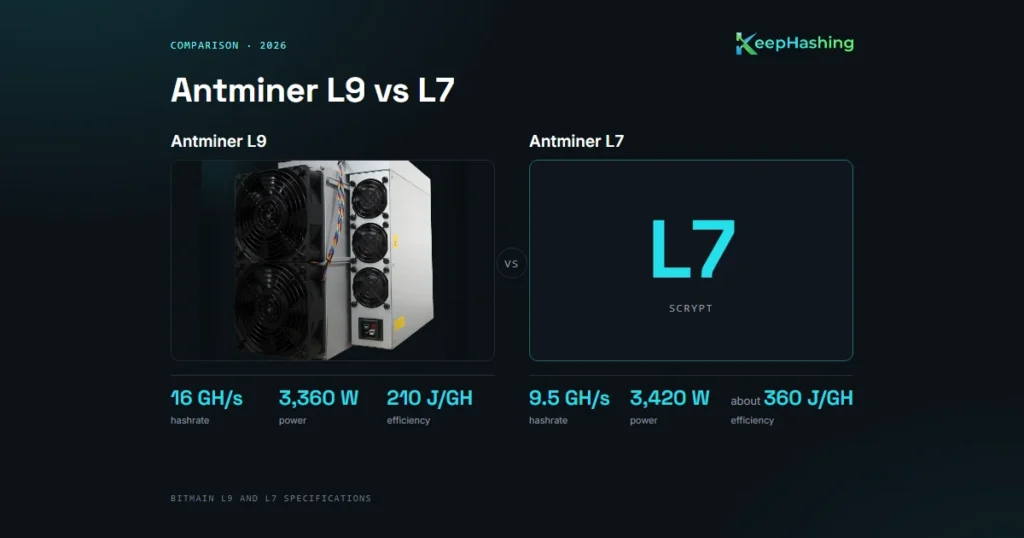
The Antminer L9 and L7 are Bitmain’s scrypt ASIC miners: machines built to mine Litecoin, not bitcoin. On Bitmain’s own figures, the L9 does 16 GH/s on 3,360 W, which works out at 210 J/GH. The top L7 bin does 9.5 GH/s on 3,420 W, about 360 J/GH. The two draw almost the same power, but the L9 does about 1.7 times the work.
At UAE electricity rates, that efficiency gap is the whole comparison. This guide sets out the published specs, the power gap in AED at DEWA and ADDC rates, the heat limits that matter in a Gulf summer, and what to check if you are offered a used L7.
What a scrypt ASIC miner is
An ASIC miner is built to run one algorithm only. Bitcoin uses SHA-256; Litecoin uses scrypt. A scrypt machine cannot mine bitcoin, and a bitcoin machine cannot mine Litecoin. If the hardware itself is new to you, start with what an ASIC miner is.
Bitmain lists the coins each model supports. For the L9, its spec page names Litecoin and Dogecoin among the scrypt coins it mines Bitmain L9 specification. Its algorithm list places the L7 under scrypt and Litecoin Bitmain, Algorithms and Corresponding ANTMINERs. How your pool pays across those coins is a question for the pool.
The L7 is the earlier generation.
Antminer L9 vs L7: the published specs
| Antminer L9 | Antminer L7 (9.5 GH/s bin) | |
|---|---|---|
| Hashrate | 16 GH/s (±3%) | 9.5 GH/s (±3%) |
| Power on wall at 25 C | 3,360 W (±5%) | 3,420 W (±10%) |
| Efficiency | 210 J/GH | about 360 J/GH |
| Input | 220 to 277 V, 20 A | 200 to 240 V, two inputs at 10 A each |
| Noise | 75 dBA | Not listed |
| Operating temperature | -20 to 45 C | 0 to 40 C |
| Dimensions | 400 x 195 x 290 mm | 370 x 195.5 x 290 mm, including PSU |
| Net weight | 14.2 kg | 13.5 kg, including PSU |
Bitmain L9 specification, updated 26 December 2024 Bitmain L7 specification, updated 11 May 2023
Two notes on reading Bitmain’s L7 page. First, it lists eight bins, from 7.8 GH/s at 2,810 W up to 9.5 GH/s at 3,420 W, all at the same efficiency, so a lower L7 bin draws less power but costs the same per GH. Second, the page’s unit labels are inconsistent. The efficiency figure here is worked out from Bitmain’s own power and hashrate: 3,420 W ÷ 9.5 GH/s = 360 J/GH.
Bitmain also gives the L7 a wider power tolerance than the L9: ±10% against ±5%.
What the efficiency gap costs in electricity
Compare the two at the same output. Producing the L9’s 16 GH/s at the L7’s 360 J/GH would take 5,760 W. The L9 does it on 3,360 W. The gap is 150 J/GH × 16 GH/s = 2,400 W, running continuously.
Over a 30-day month, that is 2,400 W × 24 × 30 = 1,728 kWh.
The rates used, as published:
- DEWA, Dubai. DEWA bills residential and commercial premises on the same slab table: 0.230 AED per kWh up to 2,000 kWh a month, 0.280 to 4,000, 0.320 to 6,000, and 0.380 above 6,000. Industrial connections pay 0.230 AED up to 10,000 kWh and 0.380 above. A fuel surcharge of 0.060 AED applies to every kWh, and 5% VAT applies to the bill. On a premises already above 6,000 kWh a month, a miner’s kWh land in the top band, at a marginal 0.44 AED DEWA slab tariff, checked October 2026.
- ADDC, Abu Dhabi. 20 fils per kWh for commercial premises. ADDC’s page says charges include 5% VAT; it is titled 2025 but reads “Effective 01/01/2018”, so check the current rate on addc.ae ADDC business rates and tariffs.
- A hosting facility. Published UAE hosting rates ranged from about 6 to 8 US cents per kWh in September 2026. That is market context from provider pages, not our price.
| Rate | Monthly cost of the 1,728 kWh gap |
|---|---|
| ADDC commercial, 0.20 AED | about AED 346, VAT included per ADDC |
| DEWA top slab plus fuel surcharge, 0.44 AED | about AED 760, before 5% VAT |
| Hosting at 6 US cents | about USD 104 |
| Hosting at 8 US cents | about USD 138 |
Formula
Watts gap = hashrate (GH/s) × J/GH gap
Monthly kWh = watts gap ÷ 1,000 × 24 × 30
Monthly cost = monthly kWh × your marginal rate per kWh (add any surcharge, then VAT)
Our guide to bitcoin mining electricity cost in the UAE runs the same arithmetic for other machines.
For each machine on its own: one L9 at 3,360 W uses about 2,419 kWh a month, and one 9.5 GH/s L7 at 3,420 W about 2,462 kWh. Almost the same bill, for very different output.
Heat: the 40 C question
In the UAE, the operating range matters as much as efficiency. Bitmain lists the L9 at -20 to 45 C and the L7 at 0 to 40 C. In an unconditioned room, warehouse or container, intake air above 35 C is normal for months of a UAE summer. The L7’s published ceiling is 5 C lower than the L9’s, so it runs out of headroom first.
Both machines turn their full draw into heat, about 3.4 kW each, around the clock. Either one needs conditioned air or a hosted rack through a Gulf summer. If you have nowhere suitable to run it, see how ASIC miner hosting works.
The wiring differs too. The L9 takes 220 to 277 V at 20 A. The L7 takes 200 to 240 V on two input cords at 10 A each. Plan the sockets and breakers for the machine you actually buy.
New L9 or used L7
In practice, a buyer weighing these two is often choosing between a new L9 and a used L7.
A new unit ships sealed, so the manufacturer’s warranty stays intact. Bitmain’s warranty-check article says new miners outside the 19 series are covered for “generally 180 days” from the official dispatch date Bitmain, Miner Warranty Check. Check the serial with Bitmain’s lookup before you pay.
A used L7 trades warranty for test evidence. Check three things before you pay:
- The bin. Bitmain lists eight L7 bins. The label, the dashboard and the quote should agree on which one you are buying.
- Watts per GH at the wall. Measure power with a meter and divide by the hashrate the pool reports. On Bitmain’s figures, every L7 bin should land near 360 J/GH, within the ±10% power tolerance.
- A recorded run. At least 24 hours on a pool, not a ten-minute demo.
Used units we sell are bench-tested at our Deira workshop before sale. See our tested used miners.
Which one for which buyer
A buyer on DEWA’s top slab. The gap is worth about AED 760 a month for the L9’s output. At that rate, efficiency carries most of the decision.
A buyer on a lower commercial or hosting rate. The gap shrinks with the rate, to about AED 346 at ADDC’s commercial rate. A tested used L7 can make sense if the quote reflects its lower output per watt.
A site that cannot hold intake air below 40 C. The L9’s published 45 C ceiling gives more room; the L7’s 40 C does not.
Whichever you choose, no one can tell you in advance what a scrypt miner will earn. That depends on coin prices and network difficulty over the time it runs, which nobody controls.