
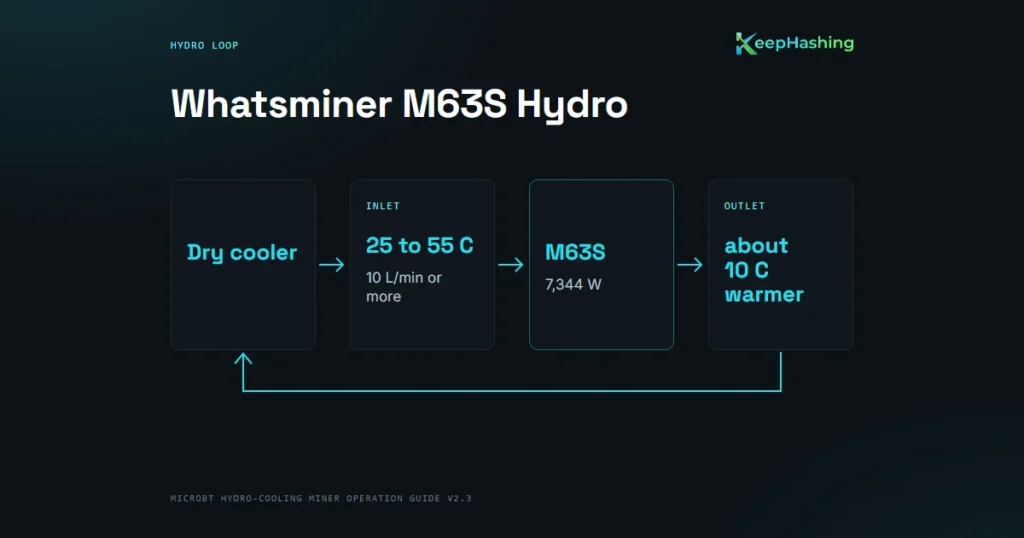
The Whatsminer M63S is a water-cooled bitcoin miner. MicroBT lists it at 408 TH/s on 7,344 W, which is 18 J/TH, on a three-phase 380 to 480 V supply. It has no fans. Its heat leaves through a coolant loop, and that loop has to be built, controlled and maintained to limits MicroBT sets out in its hydro operation guide.
So the M63S is a site decision before it is a machine decision. This guide covers the three questions a UAE buyer has to answer first: can the site supply the power, can the loop hold MicroBT’s limits, and if not, can a hosting facility do it for you. For the model itself, see our Whatsminer M63S page, and for the air-cooled alternatives, the full Whatsminer range in Dubai.
The published specs
| Whatsminer M63S | |
|---|---|
| Hashrate | 408 TH/s |
| Power | 7,344 W |
| Efficiency | 18 J/TH |
| Power supply | AC 380 to 480 V, three-phase plus ground, 10 kW input |
| Cooling | Hydro, about 1 L of coolant in the unit |
| Size with handle | 86 x 483 x 663 mm |
| Net weight | 27.5 kg |
MicroBT M63S product page, checked 29 October 2026
408 × 18 = 7,344, so the listing’s figures reconcile. The 483 mm width is a standard 19-inch rack, and 86 mm is 2U, so the M63S is built to sit in a rack, not on a shelf.
Power: three-phase only
The M63S cannot run on a single-phase socket. Its supply is three-phase 380 to 480 V with a ground, and MicroBT rates the input at 10 kW. In practice that means a commercial or industrial connection with a three-phase distribution board sized for the number of units, designed by an electrician.
Running continuously, one M63S uses 7.344 kW × 24 × 30 = about 5,288 kWh a month. That is before the loop’s own pumps and the dry cooler’s fans, which are not in the miner’s figure.
What that costs at published UAE rates:
- DEWA, Dubai. DEWA bills residential and commercial premises on the same slab table: 0.230 AED per kWh up to 2,000 kWh a month, 0.280 to 4,000, 0.320 to 6,000, and 0.380 above 6,000. Industrial connections pay 0.230 AED up to 10,000 kWh and 0.380 above. A fuel surcharge of 0.060 AED applies to every kWh, and 5% VAT applies to the bill. On a premises already above 6,000 kWh a month, a miner’s kWh land in the top band, at a marginal 0.44 AED DEWA slab tariff, checked October 2026.
- ADDC, Abu Dhabi. 20 fils per kWh for commercial premises. ADDC’s page says charges include 5% VAT; it is titled 2025 but reads “Effective 01/01/2018”, so check the current rate on addc.ae ADDC business rates and tariffs.
- A hosting facility. Published UAE hosting rates ranged from about 6 to 8 US cents per kWh in September 2026. That is market context from provider pages, not our price.
| Rate | One M63S, 5,288 kWh a month |
|---|---|
| ADDC commercial, 0.20 AED | about AED 1,058, VAT included per ADDC |
| DEWA top band plus fuel surcharge, 0.44 AED | about AED 2,327, before 5% VAT |
| Hosting at 6 US cents | about USD 317 |
| Hosting at 8 US cents | about USD 423 |
Formula
Monthly kWh = watts ÷ 1,000 × 24 × 30
Monthly cost = monthly kWh × your marginal rate per kWh (add any surcharge, then VAT)
Cooling: the limits MicroBT sets
MicroBT’s hydro operation guide sets the conditions the loop must hold. For the M63S, M63S+, M63S++, M63 and M53S++, the figures are MicroBT, WhatsMiner Hydro-Cooling Miner Operation Guide V2.3, linked from MicroBT support article 485:
| Condition | MicroBT’s limit |
|---|---|
| Inlet coolant temperature | 25 to 55 C in normal mode; 25 to 45 C in high-performance mode |
| Temperature control | Within ±2 C |
| Flow per miner | 10 L/min or more, held within ±10% |
| Inlet to outlet rise | About 10 C in normal mode, 14 C in high-performance mode, at 10 L/min |
| Pressure drop across the miner | About 68 kPa at 10 L/min |
| Coolant pressure | 400 kPa or less |
| Coolant pH | 7 to 8.7 |
| Working humidity | 5 to 85% RH, non-condensing |
Those flow and temperature figures agree with each other. Ten litres of water a minute warming by 10 C carries away about 7 kW, which is the miner’s draw. If flow drops, the outlet runs hotter; if the inlet swings, the miner’s temperature swings with it. Both are the failures MicroBT’s guide warns about.
Three points matter most in the UAE.
The inlet ceiling decides the dry cooler. The loop rejects heat to outside air, usually through a dry cooler. A UAE summer passes 35 C for months, so the cooler has to bring coolant back down to the inlet limit on the hottest afternoon of the year, not on an average day. High-performance mode lowers the ceiling to 45 C, which makes that job harder. Size the cooler for your peak.
Pressure has a hard limit. MicroBT says coolant pressure above 400 kPa can deform the cooling plates and cause leaks, and that it takes no responsibility for damage from pressure outside its range. Pump selection and a relief valve are part of the miner’s warranty position, not an afterthought.
The coolant is a maintained product. MicroBT specifies pure or distilled water, a corrosion inhibitor and antifreeze, mixed to a ratio set by the freezing point you need. It asks for pH, conductivity and appearance to be tested every two months, other indicators every six months, and recommends replacing the coolant after a year. Coolant that falls outside its table must be replaced at once, and MicroBT again disclaims damage from coolant that does not meet it. Keep the test records.
MicroBT also says to empty the miner of liquid for storage and transport. A unit that arrives with coolant in it, or a used unit with no coolant history, is worth questioning.
What the miner reports when the loop is wrong
The M63S logs loop faults as error codes. MicroBT’s error-code table includes 620 (liquid temperature protection), 652 (liquid temperature fluctuation), 507X (liquid velocity abnormal) and 5079 (flow rate too slow). Each one points at the loop before the miner. See our guide to Whatsminer error codes for what each family means.
Does it suit a home or an office?
No. It needs a three-phase supply, a rack, a coolant loop with controlled temperature, flow and pressure, a dry cooler outside, and a coolant test routine. None of that belongs in a home. Our guide to hydro and immersion cooling in the GCC covers when a site justifies a loop at all.
Hosting fit: what to ask a facility
If you want the M63S without building the loop, the machine has to go to a facility that already runs one. A quote for an air-cooled rack position does not cover a hydro unit, so ask before you buy the machine:
- Do you run a hydro loop for MicroBT units? A cooling distribution unit, dry coolers and quick-connect manifolds, not air racks.
- What inlet temperature do you hold, and how tightly? It has to stay inside MicroBT’s range for the mode you will run, within ±2 C, through the summer.
- What flow and pressure does each position get? At least 10 L/min per miner, at no more than 400 kPa.
- What coolant do you use, and can I see the test log? Inhibitor and antifreeze in the loop, tests every two months.
- Is the power three-phase 380 to 480 V at each position?
- What is the rate per kWh, and does it include cooling? Compare like with like.
Our ASIC miner hosting is a placement service: we match your machine to a facility and you keep ownership, with the pool paying your own wallet. For an M63S, we confirm whether a hydro position is available before you commit to the machine.
Before you buy
- Settle the site first. Your own three-phase site with a loop, or a hosting facility with hydro positions. Without one of these, do not buy the machine.
- Check the serial. Look the serial up with MicroBT before you pay, whoever you buy from.
- Know the warranty limits. MicroBT’s warranty terms on its product pages exclude unauthorised disassembly, unofficial firmware, overclocking, damage from the operating environment and tampered serials. On a hydro unit, coolant and pressure outside MicroBT’s limits fall on the operator.
- For a used unit, ask for its loop history. Where it ran, the coolant used, and whether it was drained for transport.