
Reading the Symptom
Overheating isn’t one fault. What the machine does under heat narrows the cause considerably before you touch anything.
| What you see | What it usually means | Owner-fixable? |
|---|---|---|
| Gradual hashrate decline through the day | Ambient climbing, throttling as designed | Yes, environment |
| Hashrate drops the moment load is applied | Thermal path or airflow failure, not ambient | Partly |
| One board consistently hotter than the others | Paste, heatsink contact, or board fault on that board | No |
| All boards hot together | The room, not the machine | Yes, environment |
| Fans at maximum continuously | Machine compensating for something upstream | Partly |
| Shutdown with thermal error, restarts fine when cool | Protection working correctly; cause unresolved | Partly |
| Temperatures normal but hashrate low | Not a thermal fault; look elsewhere | Depends |
| Sensor reporting implausible values | Sensor or communication fault | No |
Two patterns are worth separating clearly. Everything hot together is a room problem. One board hot in isolation is a machine problem. That single distinction determines whether you’re solving this with ventilation or with a bench.
Safe Owner Checks, in Order
Airflow path. The machine needs unobstructed intake and exhaust with real separation between them. Hot exhaust recirculating back into the intake is the classic self-inflicted overheat, and it defeats any amount of fan capacity. Confirm nothing blocks either end and that hot air has somewhere to go that isn’t back into the machine.
Ambient temperature. Measure what the room actually is rather than what it feels like, ideally at the machine’s intake rather than across the room. In GCC summers an unventilated space climbs fast past what any air-cooled ASIC is rated to breathe. Check the rated operating ambient for your model and compare honestly. If ambient is high, no amount of cleaning fixes it. The room is the fault.
Dust. Powered down and unplugged, inspect the intake, fans, and visible heatsink surfaces. Dust load builds fast in this region and acts as insulation exactly where the machine needs transfer. Clean what’s accessible with compressed air, holding fans still so they aren’t spun beyond their rated speed. No disassembly.
Fan behaviour. Listen and look. All fans should be spinning, without grinding or oscillating speed, and the dashboard shouldn’t be reporting fan RPM errors. A failed or failing fan is a common, cheap, and fast repair, though the swap and anything beyond it belongs on a bench rather than a kitchen table.
Power quality. Unstable supply voltage makes a PSU work harder and run hotter, and heat in the PSU affects everything downstream. If other equipment on the same circuit misbehaves in summer, that’s a signal worth following.
The logs. The dashboard records board temperatures and fan speeds over time. One board running hot while others sit normal points somewhere specific. Everything hot together points at the room. Temperature trends over weeks matter as much as today’s reading: a machine that has crept upward month over month is telling you about thermal paste and dust, not about yesterday’s weather.
What Changes Over Time
A Whatsminer that ran cool for two years and struggles now hasn’t usually developed a fault. It has accumulated one.
Thermal interface material degrades over years of continuous operation, drying and losing contact quality, which raises chip temperatures gradually with nothing visibly wrong. Dust builds inside the heatsink fins where compressed air from outside doesn’t reach. Fan bearings wear and lose effective airflow long before the fan reports an error. In coastal Dubai, humidity and salt-laden air add corrosion to the list, particularly on machines run in unconditioned spaces.
None of these produce a dramatic failure. They produce a machine that throttles a little earlier each summer, which is why the useful comparison is against the machine’s own history rather than against a number on a forum.
When It’s Bench-Level
If airflow, ambient, dust, fans, and power check out and the machine still overheats, or if one board runs persistently hotter than its siblings, the remaining causes live inside: degraded thermal paste and interface material, a failing fan or fan controller, a temperature sensor reporting incorrectly, or board-level faults generating abnormal heat.
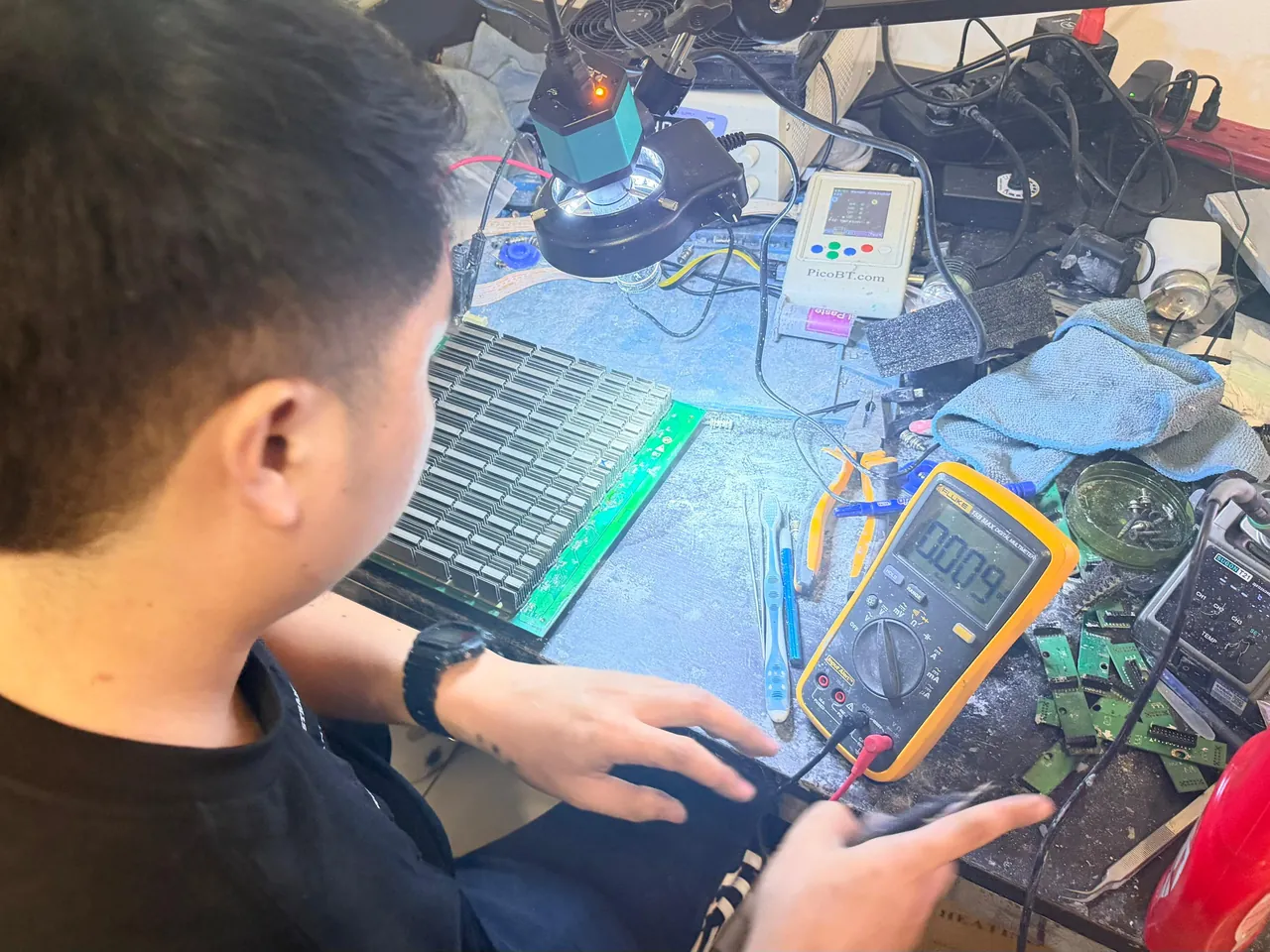
That’s disassembly territory. On a Whatsminer the thermal path service, meaning paste renewal and heatsink cleaning, is routine bench work starting at $20 per hashboard rather than an open-ended labor bill. The reason to leave it to a bench isn’t complexity for its own sake: reaching the interface means stripping to board level, and reassembly with uneven paste application creates precisely the hotspots you were trying to cure.
Our repair workshop in Deira handles exactly this. Written diagnosis and quote first, repair with tested parts, and the unit returned with a bench-test log showing temperatures under load. That’s proof the fix worked, not an assurance that it did.
The GCC Answer Nobody Wants to Hear
If your overheating is genuinely an environment problem, meaning a space that can’t be ventilated to what the machine needs through a Gulf summer, the durable fix isn’t repair at all. You can clean, repaste, and replace fans, and the machine will still throttle in August, because the constraint was never inside the case.
Two honest options exist at that point. Engineer the space properly, with real intake, real exhaust, separation between them, and ventilation sized to the heat load, which is the subject of our guide to air, hydro and immersion in GCC heat. Or move the machine somewhere already suited to it. Hosting means you keep owning the miner while someone else handles where it runs, and the problem stops being yours to solve.